CALL FOR APPLICANTS NOW OPEN for the TraiN2K European Training System
The call for applicants and selection timeline will be the following:
- Applications opening: 20th July 2026
- Deadline for applications: 30th September 2026
- Final selection & publication of trainees list: November 2026
- Onboarding starts: December 2026
Natura 2000 Training Programme:
General description and aims
The Natura 2000 Training System was created to train the next generation of Natura 2000 professionals involved the management, conservation, restoration and surveillance of Natura 2000 sites and other protected areas across Europe.
The programme includes in-presence lessons, e-learning modules and on-field training. All training costs for participants are covered by the LIFE TraiN2K project, except the participation costs (e.g. travel, food and accomodation) for the proposed optional on-field trainings that will take place after the core training programme sessions.
In order to create competent Natura 2000 experts, the project developed three different technical curricula:
- Management curriculum, focused on protected area management and the implementation of EU environmental directives
- Restoration curriculum, focused on designing and implement ecological restoration actions
- Surveillance curriculum, focused on surveillance and enforcement of protected areas
In addition to these technical curricula, all participants are required to attend a cross-cutting Soft Skills curriculum (based on the UNECE ESD Strategy 2012 and the European GreenComp 2022 framework) which will enable each trainee to develop key expertise in communication, planning, coordination and conflict resolution. The combination of each of the three technical curricula together with lessons on soft skills will complete the trainin of the following professional profiles:
- Natura 2000 Coaches (Management + Soft skills): essential skills for site managers
- Eco-Restorers (Restoration + Soft skills): essential skills to design and implement environmental restoration projects, contributing to ecosystem conservation
- Natura 2000 Rangers (Surveillance + Soft skills): essential skills for monitoring and surveillance of protected areas, particularly in the Natura 2000 network.
Course structure
In presence lessons
In-presence lessons take place at the Natura 2000 Training Institute – the Centre of Excellence for Environmental Protection (CoEEP) of the Carabinieri Corps, in Sabaudia (Italy) and, for the Ranger profile, also at a dedicated venue managed by ESMIR, in Madrid (Spain). For each of the three curricula a total of three sessions are scheduled. During each session the three courses will run simultaneously, for a total of 10 days / 80 hours of lessons (weekends excluded). The in-presence lessons will always be organized during a 14-day stay.
E-learning modules
Upon completion of the in-presence lessons, the training will continue with mandatory e-learning modules. Participants will also have the opportunity to further deepen their knowledge through additional e-learning modules related to the other two technical curricula.
On-field trainings
Another optional component, following the in-person training, will be the visits (of approximately 2-3 days) to well-managed Natura 2000 sites where trainees will be able to observe successful conservation-projects and the application of best practices for conservation measures, habitat-restoration and surveillance of ecosystems.
Tests, final exam and certification
At the end of each training phase, participants are required to pass a test aimed at verifying the knowledge acquired. Additionally, a final exam will be held at the end of the completed training programme. Having successfully passed the final exam, each trainee will receive an official certification as a ‘Natura 2000 Coach’, ‘Eco-Restorer’ or ‘Natura 2000 Ranger’, issued by the Natura 2000 Training Institute.
In addition, the names of the newly certified professionals will be included in the project platform as contact persons for their country, thereby becoming part of the European network of Natura 2000 professionals.
Courses time plan
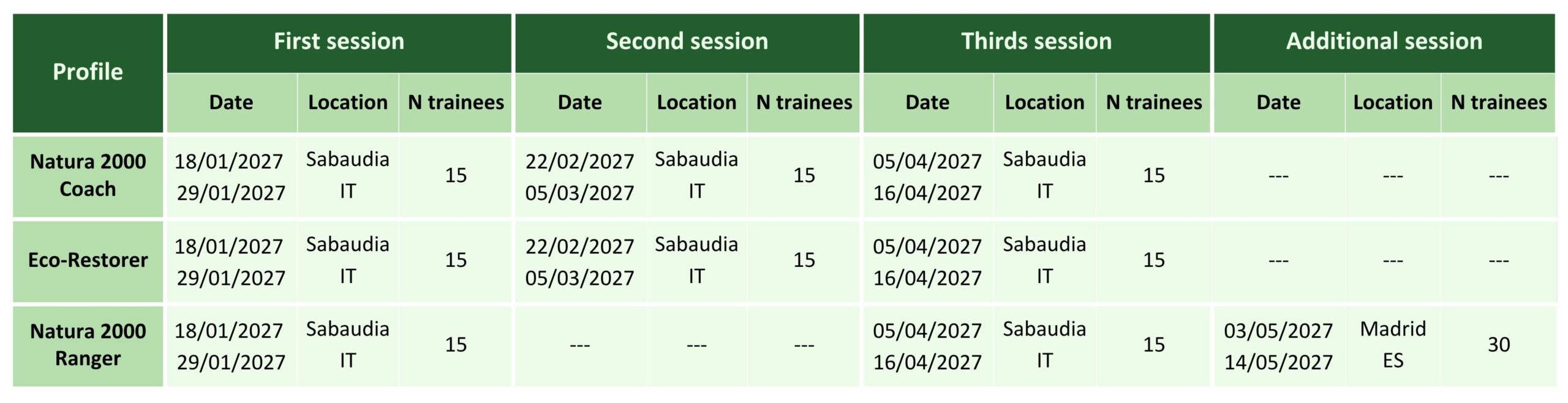
The following table specifies dates and locations of the in-presence lessons for the three profiles:
The 3 Professional Profiles
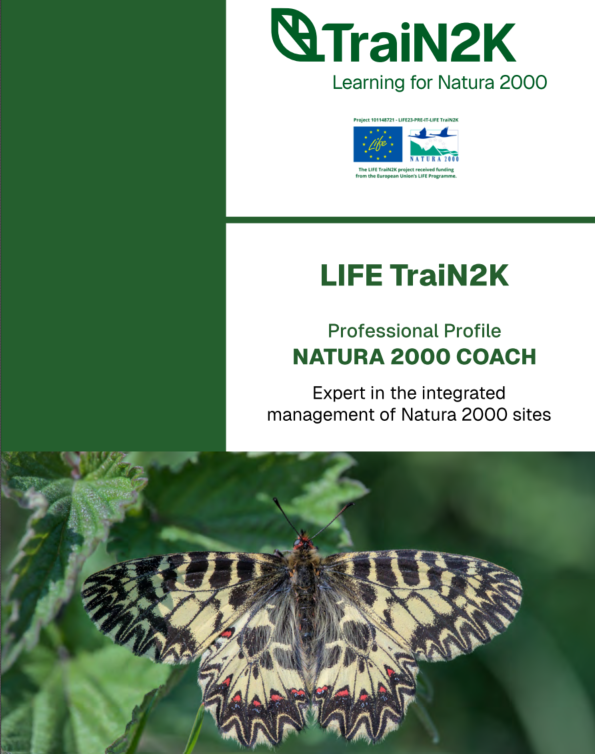
Natura 2000 Coach
Expert in the integrated management of Natura 2000 sites
Supports site managers, competent authorities, and local bodies by combining technical-scientific expertise with planning, participatory governance, and mediation skills.
Aimed at: managers of Natura 2000 sites (public bodies, private owners, research institutions, NGOs) involved in daily or strategic management.
Dates: 18-29/01/2027 ; 22/02-05/03/2027 ; 05-16/04/2027 ; in Sabaudia, IT
Eco-Restorer
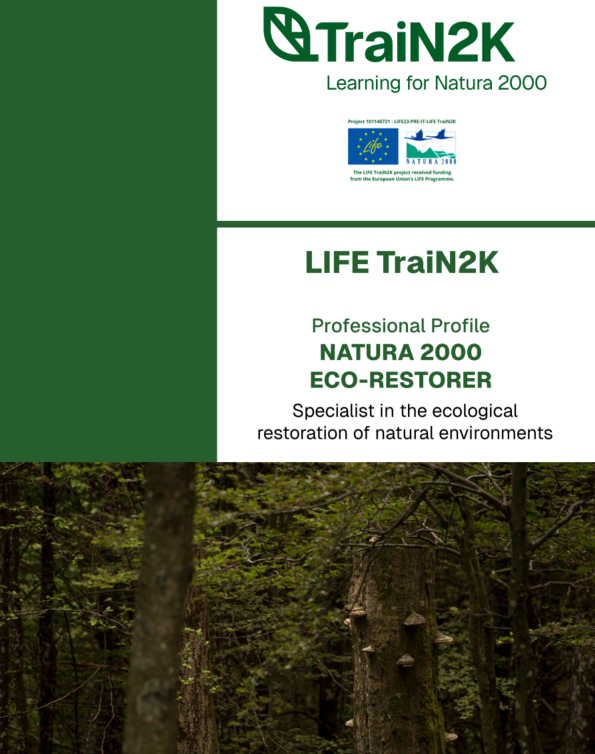
Specialist in the ecological restoration of natural environments
Designs, plans, and carries out ecological restoration interventions (wetlands, peatlands, forest, agricultural, marine and coastal habitats) in line with the EU Nature Restoration Law.
Aimed at: professionals and experts active in ecological restoration (biologists, agronomists, foresters, ecologists or similar).
Dates: 18-29/01/2027 ; 22/02-05/03/2027 ; 05-16/04/2027 ; in Sabaudia, IT
Natura 2000 Ranger
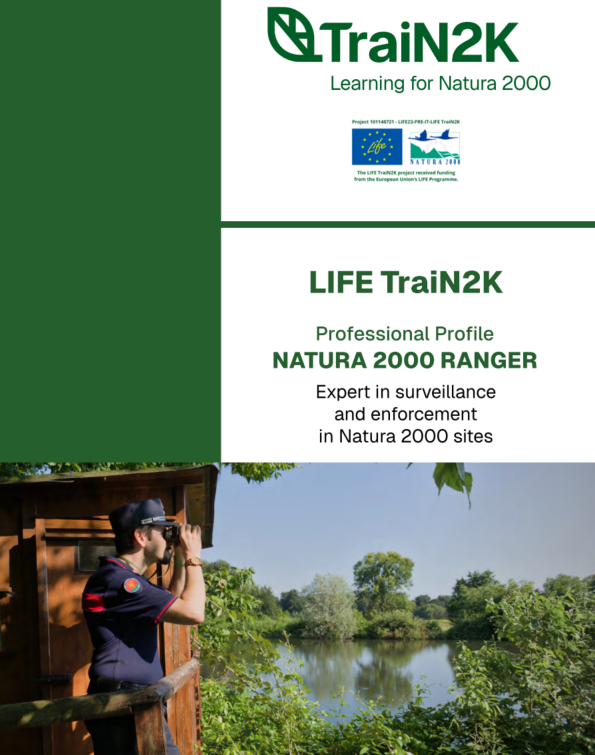
Expert in surveillance and enforcement in Natura 2000 sites
Oversees sites in the field, ensuring surveillance, control, and enforcement of environmental protection rules, coordinating with competent authorities and law enforcement
Aimed at: staff of environmental police forces, voluntary ecological guards, environmental inspectors, and monitoring bodies.
Dates: 18-29/01/2027 ; 05-16/04/2027 a Sabaudia, IT e 03-14/05/2027 in Madrid, ES
Who can apply
To be eligible, applicants must be 18 years of age or older on the date of application, hold a full degree in environmental or biological sciences (EQF level 6 or above) – or a vocational qualification in the same field (minimum 2 years, EQF level 4-5) – have a knowledge of English of at least level B2 (CEFR), and a basic proficiency with standard office/IT tools. We recommend downloading and reading the brochure for your profile of interest (Natura 2000 Coach, Eco-Restorer or Natura 2000 Ranger) before applying, to check that the requirements and training path match your professional background. Applicants should be nationals of an EU Member State; a limited number of traineeships to nationals from non-EU countries will be granted, particularly from candidate countries for EU membership or EFTA countries.
How to complete the application form
The form must be completed in English and submitted before the deadline. Fields marked with * are mandatory. It is organised in sections covering personal details, education and language qualifications, and professional experience, followed by a final part where you choose your main training profile (Natura 2000 Coach, Eco-Restorer or Natura 2000 Ranger) and, optionally, a second-choice profile. Depending on the profile(s) selected, you will be asked profile-specific questions on your professional experience and motivation. All information provided may be verified at a later stage and false declarations will result in exclusion from the selection procedure.
Selection criteria
Applications are assessed through a scoring system covering personal details, professional experience and affinity with the chosen profile. A few of the key selection criteria include: relevant educational qualifications and their alignment with the chosen profile; consistent professional experience in the nature conservation / environmental sector and relevant thematic expertise; motivation and ability to transfer acquired knowledge to colleagues and organisations (the programme aims to create a network of “knowledge multipliers”); and the relevance of your current role and career path to the selected profile.
Documents required if you pass the preselection
Candidates who pass the initial screening will be shortlisted and asked to submit additional supporting documents to confirm the information provided in the application form: Curriculum Vitae (in English, Europass format or equivalent), degree certificate / proof of professional qualification, and a language certificate (English) or equivalent documentation (e.g. relevant international experience). A letter of support from your employer/organisation and any other relevant professional certificates may also be requested, where applicable. Failure to provide the requested documents within the deadline set by the evaluators may result in exclusion from the selection process; being asked for additional documents does not imply that the application has been accepted.
How to apply
Applications for the training sessions held in the CoEEP (Sabaudia, Italy) are currently open. The later training session on Surveillance that will be held in Madrid, Spain, will include a separate Call for Applications managed directly by ESMIR.
Before applying, we recommend downloading and reading the brochure for the profile you are interested in, to make sure the requirements and training path match your professional role.
Before applying, please read the Privacy Notice on how your personal data will be processed by project’s partners for the purposes of this selection procedure.
For more information: recruitment-info@lifetrain2k.org