LIFE TraiN2K
The LIFE Project TraiN2K – Training and coaching for better management of Natura 2000 sites (LIFE23-PRE-IT-LIFE TraiN2K) aims to strengthen the management system of Natura 2000 sites by qualifying professionals. The project will provide a European hybrid training system and will offer courses for three professional profiles: Natura 2000 Coaches, Eco-Restorers and Natura 2000 Rangers and will also offer the international Master’s programme: Natura 2000 Expert.
The main aim is to train professionals from various member state countries and thus create a more connected and coherent European community for the planning, management, and protection of biodiversity in the Natura 2000 network. The courses will also improve effectiveness of management and advance habitat restoration in protected areas. In addition to the courses aimed at professionals and students, TraiN2K will also offer open e-learning courses for the public.
The LIFE Project TraiN2K aims to strengthen the management system of Natura 2000 sites by qualifying professionals and students and by providing e-learning courses for the public. This will be achieved by building a European hybrid training system, articulated around three complementary and mutually reinforcing approaches, each addressing a different audience and level of specialisation:
1. European Training System - Natura 2000
The international courses are the core-product of the Project TraiN2K's, which will offer curricula for three professional profiles: Natura 2000 Coaches, Eco-Restorers and Natura 2000 Rangers. Participants selected for these advanced training programmes will be formed through an integrated hybrid system that combines theoretical modules, to be held in the Centre of Excellence for Environmental Protection in Italy and at the ESMIR training infrastructures located in Spain. Additionally, on-line courses and field training will complete the three curricula.
Each professional profile has a tailored curriculum:
- Natura 2000 Coaches are trained in the governance and strategic management of protected sites, covering monitoring protocols, conservation-status reporting and the development of site management plans;
- Eco-Restorers specialise in the ecological restoration and active conservation of habitats, learning to design and implement rehabilitation measures for forests, wetlands, grasslands and marine environments in line with the EU Nature Restoration Law;
- Natura 2000 Rangers focus on surveillance and enforcement of protected areas. They learn how to ensure control, and enforcement of environmental protection rules, and how to coordinate with competent authorities and law enforcement.
2. Master in Natura 2000 Expert
Another important pillar of the TraiN2K project is the international second-level Master's programme: Biodiversity Governance - Natura 2000 Expert (BIOGOV), organized by the University of Tuscia (UNITUS), Department of Ecological and Biological Sciences, in partnership with the Carabinieri Forestry, Environmental and Agri-food Protection Command (CUFAA).
This 12-months, 60-ECTS programme is fully financed under the EU LIFE Programme and is open, free of charge, to European citizens holding a Master of Science degree or an equivalent second-cycle qualification. It follows a blended teaching model, combining six online thematic modules with two months of in-person field activities in Italian State Nature Reserves managed by the Carabinieri Forestali. The Master will train 20 highly qualified professionals, equipping them to operate in international environmental governance, protected-area management and biodiversity conservation initiatives, and concludes with the public defence of an individual project on a real biodiversity governance or restoration case study.
3. E-learning for the public
In addition to the courses for professionals, TraiN2K also offers open-access modules for the general public. These e-learning courses are designed to offer lessons on the following topics: the Natura 2000 network, monitoring of species and habitats of European importance, management of protected areas, environmental restoration strategies, as well as surveillance and control of protected areas.
Once registered, everyone will be able to access the on-line platform and start learning about nature and its management in Europe and about the EU Biodiversity Strategy for 2030 - Bringing nature back into our lives.
Scaling-up the training system
In addition to qualifying professionals directly, TraiN2K will apply a strategy to extend its results across Europe. This will be achieved by building an international network of Natura 2000 site managers and by organizing national workshops to engage competent authorities and site managers in target countries (including Bulgaria, Romania, Finland, Latvia, Ireland, Poland, Cyprus, Belgium, Sweden and Greece). Online workshops will be developed for the national contact points, aimed at informing them on the training system of the Natura 2000 Training Institute and on the 2nd level Master in “Natura 2000 Expert”.
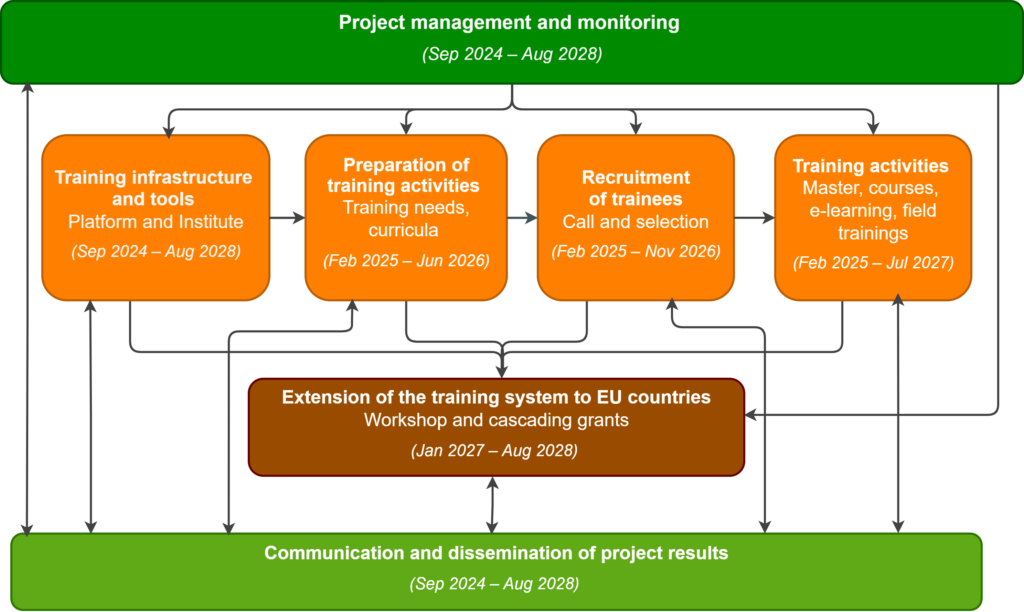
To achieve its objectives, LIFE TraiN2K involves activities over a period of 48 months (from September 2024 to August 2028). Specifically, the LIFE TraiN2K project will implement the following actions:
- Establish a comprehensive and multidisciplinary Natura 2000 Training System addressing current training needs to improve the management of Natura 2000 sites and support the implementation of the European Nature Directives.
- Establish the Natura 2000 Training Institute (Sabaudia, Italy), providing training courses, professional updates, networking and communication events. The Institute will become a long-term reference point for the Natura 2000 community, strengthening collaboration and supporting the conservation and restoration of natural ecosystems across Europe.
- Develop the TraiN2K Online Platform, hosting training programmes organised by curricula, e-learning modules and supporting material. Additionally, a database with the names of the newly certified Natura 2000 professionals will be present.
- Train and certify three professional profiles specialising in Natura 2000 topics: Natura 2000 Coaches (site management), Ecorestorers (ecological restoration), Natura 2000 Rangers (protected area surveillance).
- Development of the second-level Master "Natura 2000 Expert" (12 months, 60 ETCs), an advanced training opportunity for young graduates with a particular focus on the ecology of natural and human disturbances in a perspective of ecosustainability and in the context of global change.
- Support 10 cascading grants to develop training initiatives for Natura 2000 site managers in central and eastern European countries, strengthening their knowledge and professional skills.
- Implement a communication and promotion strategy to raise awareness of the Natura 2000 Training System and promote the new professional profiles developed by the project.
The LIFE Programme is the European Union's financial instrument that, since 1992, has promoted the implementation and development of environmental and climate legislation through co-financing projects proposed by public and private entities.
For the 2021-2027 programming cycle, LIFE has a budget of €5.4 billion, playing a key role in supporting the EU Biodiversity Strategy for 2030 and commitments to climate neutrality. In this context, the LIFE TraiN2K project represents a strategic action in the field of training and strengthening professional skills to improve the effectiveness of environmental management.
The program is divided into four subprograms:
- Nature and Biodiversity (NAT);
- Circular Economy and Quality of Life (ENV);
- Climate Change Mitigation and Adaptation (CCM and CCA);
- Clean Energy Transition (CET).
For further information, database consultation, and active calls for proposals, please visit the official LIFE Programme website.
The Natura 2000 Network is the main European instrument for nature protection and biodiversity conservation. It is a complex ecological network, established under the Habitats Directive (92/43/EEC) and the Birds Directive (2009/147/EC), which ensures the protection of rare habitats and threatened animal and plant species.
Unlike traditional nature reserves, Natura 2000 promotes a model of sustainable coexistence, where the protection of natural heritage is integrated with human activities and the local economy. The TraiN2K project was created specifically to address the challenges of managing this vast network, training new professionals such as Natura 2000 Coaches, Eco-Restorers, and Natura 2000 Rangers.
The Natura 2000 Network in Europe today:
- It involves the 27 member states of the European Union;
- It covers approximately 18% of the EU's land area and a large portion of its marine territory;
- It protects 233 habitat types, over 540 bird species, and approximately 1,390 other animal and plant species.
To learn more about the Network and discover protected sites, visit the official Natura 2000 Network portal.
Who we are
The LIFE TraiN2K project development, management, and support team is comprised of a broad and qualified project partnership, comprising nine different organizations: public-governmental, professional, expert, and research organizations, and academic and training organizations.

Leading Partner
CUFAA – Carabinieri Corps, Carabinieri Forestry, Environmental, Agri-food Unit Command, Carabinieri Biodiversity Group

Beneficiary Partner
D.R.E.Am. Italia – Cooperative Society for Engineering, Forestry and Environmental Services
Beneficiary Partner
CREA – Council for Agricultural Research and Economics, Research Center for Plant Protection and Certification
Beneficiary Partner
UNITUS – University of Tuscia, Department of Ecological and Biological Sciences
Beneficiary Partner
Eurosite – the European Land Conservation Network

Beneficiary Partner
WEEC Network – Institute for Environment and Education Scholé Future
Beneficiary Partner
ESMIR – Ministerio del Interior, SEPRONA (Servicio de Protección de la Naturaleza) – Guardia Civil

Beneficiary Partner
CESAN – Commandement pour l’Environnement et la Santé

Associated Partner
GNR – Guarda Nacional Republicana